 MüzeKartGeçerli
Knidos Archaeological Sitevisitor guide.
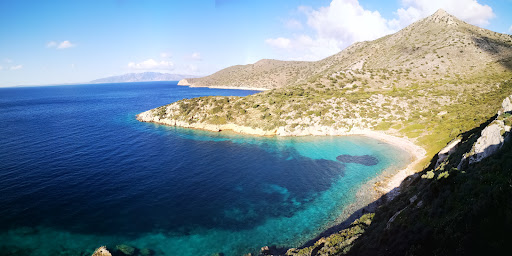
Situated on Cape Tekir at the confluence of the Aegean and the Mediterranean on the westernmost tip of the Reşadiye Peninsula in Datça, Muğla, the ancient city of Knidos is one of the most prominent centers among Western Anatolian coastal cities. The city consists of two parts: the mainland and the island section known as 'Kap Krio'. As Strabo noted, Knidos appears as a 'double city' and is terraced owing to the mountainous terrain. The sea between the island and the mainland was subsequently filled, creating two separate harbors. The smaller one to the north was called the Northern Harbor and used for military purposes. The southern harbor on the other side was reserved for commercial vessels. Today, the breakwater remains enclosing the harbor entrance and the tower at the northern harbor can still be seen. The city of Knidos was laid out according to the Hippodamian grid plan. Consequently, four wide avenues running east-west parallel to each other intersect with a perpendicular north-south avenue. Adapted to the topography, streets and avenues intersect sometimes with stairways and sometimes at right angles. On the mainland section stand the acropolis and city walls, with the 'Sanctuary of Demeter' and the 'Great Theater' to the east. Across the city are seven known churches, a Hellenistic villa, and an Odeion to the south. North of this area lies the 'Sanctuary of the Muses'. In the northeast of the mainland stands a Corinthian-order Temple. To the west is the 'Round Temple Terrace', and immediately below it the 'Apollo Terrace'. The 'Apollo Karneios' festivals were held in this area, where spectators watched from rows of seating on the north side of the terrace. Between the terraces are a propylon and an east-west avenue. A large drainage system was identified here, and remains of a Bouleuterion can be seen nearby. South of the terrace lie remains of a temple dubbed the 'Pink Temple' because of the color of its stones. North of the large harbor sit the 'Small Theater', an area named the 'Dionysus Terrace' after the temple of Dionysus to the west, and a Stoa extending down to Harbor Street. Artifacts from the stoa ranging from the Early Hellenistic period to the 2nd century AD are noteworthy. Another excavated area is 'Harbor Street', extending from the small harbor to the propylon. Just west of this avenue stands Church 'D', while a 'fountain structure' was unearthed in the southern section. From its inscription, it is understood that 'the fountain was built and dedicated to the public by Boulakrates, the city water director'. Excavations on Kap Krio revealed terraced rows of shops, workshops, and dwellings, indicating settlement here until around the 5th century AD. The city necropolis lies at the eastern entrance, with notable tomb types spread across an expansive area of roughly 7 km. The city was an important commercial and tourist hub. Renowned for its wines, the city exported its vintage widely. From the 6th century BC onward, Knidos played a vital role in the Hellenic world. In addition to being a major ancient trade center, it was also a city of culture and art. The statue of Aphrodite sculpted for Knidos by Praxiteles in the 4th century BC was celebrated in archaeology and contributed greatly to the city's renown. In the early 19th and 20th centuries, many Western travelers and researchers visited Knidos during explorations of Anatolian coasts, publishing their studies. O. Benndorf and G. Niemann in 1881, Th. J. Bent in 1888, J. L. Myres in 1893, and G. Cousin in 1897 worked on the Knidos peninsula. In summer 1904, Alfred Philippson produced a topographic and geographic description of the peninsula through rigorous fieldwork. Research on Knidos was initiated in the 19th century by W. M. Leake on behalf of the Society of Dilettanti, who illustrated and published the monuments of Knidos. Primary excavations and investigations were conducted by C. Newton on behalf of the British Museum between 1857 and 1859, with numerous discovered artifacts transported to the British Museum. Roughly a century later, British scholar G. E. Bean traveled the Reşadiye Peninsula, providing information on the founding and history of Knidos. Excavations were conducted in 1967–1977 led by Iris Cornelia Love on behalf of Long Island University (USA), and in 1988–2006 led by Prof. Dr. Ramazan Özgan from Selçuk University. In 2014, excavations and research continued under the direction of Assoc. Prof. Dr. M. Ertekin Doksanaltı from Selçuk University. DOWNLOAD MUSEUM BROCHURE NEARBY MUSEUMS BODRUM ANCIENT THEATRE BODRUM MAUSOLEUM MEMORIAL MUSEUM BODRUM ZEKİ MÜREN ART MUSEUM MARMARİS MUSEUM UNDERWATER ARCHAEOLOGY MUSEUM SEDİR ISLAND ARCHAEOLOGICAL SITE
Let AI build your tour plan
Knidos Archaeological Site
3-Stop Personal Tour Plan
VISIT INFO
Museum visit information
Address
Yazı, Çevre Yolu, 48900 Datça/Muğla, Türkiye
Ticket
Not listed
Opening Hours
- Monday08:30–21:00
- Tuesday08:30–21:00
- Wednesday08:30–21:00
- Thursday08:30–21:00
- Friday08:30–21:00
- Fridayrtesi08:30–21:00
- Sunday08:30–21:00
Phone
+90 252 412 14 59
GUIDES
Before you visit
Frequently Asked Questions (Knidos Archaeological Site)
Monday: 08:30–21:00 · Tuesday: 08:30–21:00 · Wednesday: 08:30–21:00 · Thursday: 08:30–21:00 · Friday: 08:30–21:00 · Fridayrtesi: 08:30–21:00 · Sunday: 08:30–21:00
Neleri Meşhur İşbirliği
Knidos Archaeological Site çevresinde ne meşhur?
Neleri Meşhur'da bakın — lezzet, gezi ve yöresel keşif tek yerde.
MUĞLA
Explore in the same city

Afife Kuyusu
Amyntas Rock Tombs
