 MüzeKartGeçerli
Midas Yazılıkaya Archaeological Sitevisitor guide.
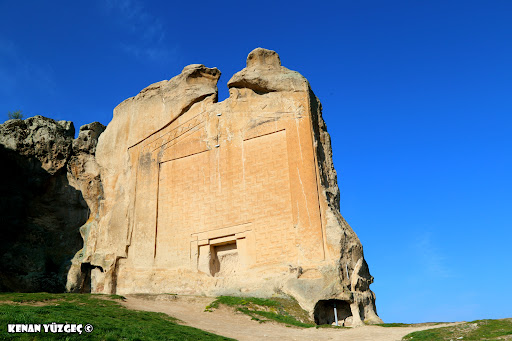
Yazılıkaya / Midas City is located at the southern tip of the Yazılıkaya Valley, immediately west of Yazılıkaya village belonging to the Han district of Eskişehir. It was established atop the Yazılıkaya plateau composed of volcanic tuff rocks. Its length is 650 m and its width is 320 m. Its height above the valley floor reaches roughly 60–70 m. Investigations into the Mountainous Phrygia Region and Midas City commenced in 1800 with the discovery of the Yazılıkaya / Midas monument by William Martin Leake and his associates. Throughout the 19th and the first half of the 20th centuries, numerous European travelers and scholars conducted research in the region. In 1826, French travelers A. de Laborde and L. de Laborde found the Unfinished Monument, and in 1834 Charles Texier discovered the Areyastin / Arezastis (Little Yazılıkaya) monument. In 1881, British historical geographer and epigrapher William M. Ramsay arrived in Mountainous Phrygia, continuing his investigations in the area between 1881–1884 and in 1907. W. Ramsay was the first scholar to designate Yazılıkaya as 'Midas City'. Between 1937 and 1939, Art Historian Albert Gabriel, Director of the French Archaeological Institute in Istanbul, initiated the first systematic archaeological excavations at Yazılıkaya together with Dutch archaeologist C. H. Emilie Haspels. In 1948, the second campaign of excavations commenced at Yazılıkaya on behalf of the French Archaeological Institute in Istanbul, conducted under the field supervision of Istanbul University faculty member Halet Çambel. In 1946, C. H. Emilie Haspels initiated extensive surface surveys across the Mountainous Phrygia Region, continuing intermittently until 1958. These comprehensive surveys, spanning a vast period from Prehistoric antiquity to the Ottoman era, were published as a seminal book. In 1984, Fahri Işık arrived in the Mountainous Phrygia Region to examine Phrygian rock monuments, drawing comparisons between Urartian and Phrygian rock-cut monuments. Between 1990 and 1993, the Eskişehir Archaeology Museum Directorate carried out cleaning works around the monument and cisterns in the Yazılıkaya-Midas city. Between 1992 and 1996, Taciser Tüfekçi-Sivas conducted extensive research on Phrygian rock monuments in the territory and published her doctoral dissertation. Surveys and excavations reveal that Midas City was elevated to a privileged sanctuary status by the Phrygians, adorned with numerous rock-hewn religious structures of the most monumental scale. For the Phrygians, capital Gordion served as the most powerful political center of the state, while Midas City remained the most sacred religious hub from the very inception of the kingdom. Excavation findings indicate that human settlement in the vicinity dates back to the 3rd millennium BC. The earliest Phrygian settlement began in the final quarter of the 8th century BC. Following the political fall of the Phrygian Kingdom, the city was never abandoned; during the Persian, Hellenistic, Roman, and Byzantine epochs, Phrygian rock monuments continued in active use with minor modifications. It is believed that the city was enclosed by fortifications in the Phrygian period. Today, not a single stone belonging to the defensive wall remains in place. Stepped bedrock foundation sockets cut at strategic points along the natural rock rim encasing the settlement demonstrate the existence of a defensive rampart. These sockets suggest multiple fortification rings in certain locations. The principal city entrance lies to the east. The rock-cut ramped avenue is celebrated as the Royal Road. Figurative reliefs are carved along rock masses lining the ramp. Monumental stepped altars carved from native bedrock atop the plateau, two vaulted rock tunnels accessed via rock stairs, and colossal rock cisterns on the southwest lower terrace constitute the most prominent structures. High tuff rock formations surrounding the settlement host numerous rock-cut facade monuments, stepped altars, votive niches, and chamber tombs. The monumental and miniature rock-cut sacred monuments situated in Midas City and the Yazılıkaya Valley reflect the Phrygians' profound reverence and devotion toward Mother Goddess Matar Kubileya, who personified nature in all its living vibrancy. Although the architectural designs of these facades, altars, and niches vary, functionally every one of them is an open-air sanctuary dedicated to the cult of Mother Goddess Matar Kubileya. The gable-roofed facades with triangular pediments represent rock-cut fronts of Phrygian residences. The pediment and facade are ornamented with geometric and vegetal patterns, bearing striking resemblance to Phrygian woodwork decoration. The pivotal component of this facade is the central doorway niche housing the goddess's statue or relief. Thus, behind the doorway opening into the heart of the rock, the Phrygian worshiper could witness the epiphany of Mother Goddess, sensing her presence. Altars were sacred places where prayers were offered, animal sacrifices performed, and votive gifts presented. Steps in front led to round-headed, rectangular-bodied idols representing the goddess; the finest examples are preserved at Midas City. Niches are shallow oval or rectangular recesses carved on steep rock faces at accessible heights, accommodating sockets for goddess figurines on their rear walls. Deemed worthy of nomination for inclusion in the UNESCO World Heritage List, Yazılıkaya / Midas City represents the most valuable cultural treasure of Mountainous Phrygia to be passed on to future generations. DOWNLOAD MUSEUM BROCHURE NEARBY MUSEUMS PESSINUS ARCHAEOLOGICAL SITE ETİ ARCHAEOLOGY MUSEUM
Let AI build your tour plan
Midas Yazılıkaya Archaeological Site
3-Stop Personal Tour Plan
VISIT INFO
Museum visit information
Address
Gökçegüney, 26970 Seyitgazi/Eskişehir, Türkiye
Ticket
Not listed
Opening Hours
- Opening08:00
- Closing17:00
- Box office closing16:30
- Closed daysOpen every day
Phone
02225847672
GUIDES
Before you visit
Frequently Asked Questions (Midas Yazılıkaya Archaeological Site)
Opening: 08:00 · Closing: 17:00 · Box office closing: 16:30 · Closed days: Open every day
Neleri Meşhur İşbirliği
Midas Yazılıkaya Archaeological Site çevresinde ne meşhur?
Neleri Meşhur'da bakın — lezzet, gezi ve yöresel keşif tek yerde.
ESKİŞEHİR
Explore in the same city

Anadolu Üniversitesi Cumhuriyet Tarihi Museum
Berna Türemen Kedi Sanat Evi
