 MüzeKartGeçerli
MAGNESIA ÖRENYERİvisitor guide.
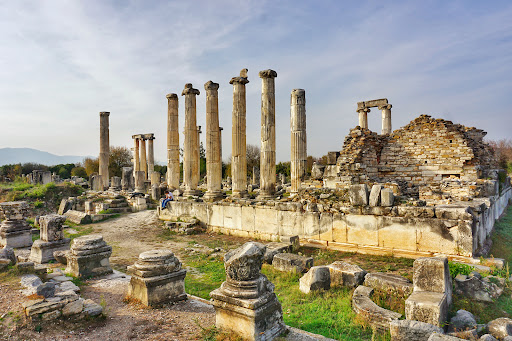
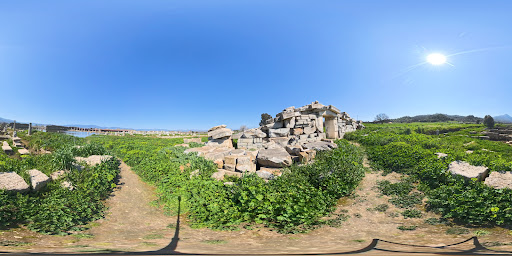
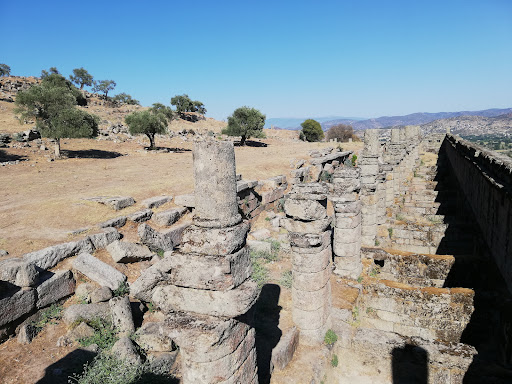
Magnesia ad Maeandrum is situated on the Ortaklar–Söke highway within Tekin Village, Ortaklar subdistrict of Germencik District, Aydın Province. According to foundation legends and ancient sources, the city was established by a tribe originating from Thessaly known as the Magnetes. Led by the prophecy of Apollo and their chieftain Leukippos, the Magnetes landed ashore along the banks of what was then an inlet of modern Lake Bafa; while the precise location of the initial settlement remains uncertain, ancient texts record it lay beside the Maeander River. Due to persistent river flooding, malaria epidemics, and the need for stronger defense against the Persians, the Magnetes re-established their city around 400 BC at its present location beside the Gümüşçay stream. Entering the hegemony of the Seleucids and subsequently the Pergamon Kingdom during the Hellenistic Period, Magnesia retained its preeminence under Roman rule, becoming an episcopal seat in the Byzantine Era. Enclosed by a defensive wall covering roughly 1.5 km in diameter, Magnesia featured a regular Hippodamian grid plan of avenues and streets, occupying a vital strategic and commercial junction within the Priene–Ephesus–Tralles triangle. Magnesia suffered comparatively little catastrophic destruction, largely because extensive silt and alluvium washed down by river inundations and torrents from Mount Thorax (Gümüş Dağı) gradually blanketed the monuments. Following brief preliminary surveys, the first excavations were carried out in 1891 by Carl Humann on behalf of the Berlin Museum. Over 21 months, the theater, Temple of Artemis and its altar, the agora, Temple of Zeus, and the prytaneion were partially or completely brought to light. Masterpieces discovered at Magnesia are exhibited in museums in Paris, Berlin, and Istanbul. Almost a century after excavations concluded in 1893, new excavations began in 1984 under the Ministry of Culture and Ankara University to rescue the gradually vanishing city. Magnesia's enduring renown in antiquity derived from the legendary architect Hermogenes. According to ancient Roman architectural writer Vitruvius, Hermogenes was the pioneer who first implemented the octagonal pseudodipteral temple design, his ultimate masterpiece being the Temple of Artemis Leukophryene at Magnesia. Erected in the Hellenistic Period (3rd–2nd centuries BC) over the remains of an Archaic predecessor (6th century BC), Hermogenes's Ionic temple featured 8 by 15 columns, measuring 67.50 by 40 meters to rank as the fourth-largest temple in Anatolia. In front of the temple stood a monumental 'U'-shaped altar that served as the architectural prototype for the Pergamon Altar of Zeus, adorned with dramatic friezes and statues reaching two human statures in height. Another monumental edifice is the theater, now largely buried beneath sediment; dating to the late 2nd century BC, it represents one of the rare surviving structures conforming closest to Vitruvius's canonical theatrical plan. Among structures re-buried after 19th-century excavations were the vast agora (measuring 26,000 m2 to rank among the largest public plazas of its era) and the Temple of Zeus, whose facade is showcased today in Berlin's Pergamon Museum. Surviving monuments visible today belong mostly to the Roman Empire and later eras: the gymnasium educational sports complex, Roman baths replicating Faustina Baths at Miletus on a smaller scale, an odeon between theater and Artemision, a 25,000-spectator stadium, an unfinished theater-planned theatron aqueduct structure, a commercial basilica, Byzantine structures, and the Byzantine circuit wall enclosing the Artemision. The transverse-plan 15th-century Çerkez Musa Mosque is the site's sole Islamic monument. Standing on par in renown and archaeological grandeur with celebrated neighboring metropolises such as Ephesus, Miletus, Aphrodisias, and Hierapolis, be sure to explore and experience this remarkable ancient city. DOWNLOAD MUSEUM BROCHURE NEARBY MUSEUMS AYDIN ARCHAEOLOGY MUSEUM PRIENE ARCHAEOLOGICAL SITE DIDYMA APOLLO TEMPLE MILETUS ARCHAEOLOGICAL SITE KARACASU ETHNOGRAPHY MUSEUM APHRODISIAS MUSEUM AND ARCHAEOLOGICAL SITE
Let AI build your tour plan
MAGNESIA ÖRENYERİ
3-Stop Personal Tour Plan
VISIT INFO
Museum visit information
Address
Tekin, 09330 Germencik/Aydın, Türkiye
Ticket
Not listed
Opening Hours
- Opening08:30
- Closing17:30
- Box office closing17:00
- Closed daysOpen every day
Phone
02562252259
Frequently Asked Questions (MAGNESIA ÖRENYERİ)
Opening: 08:30 · Closing: 17:30 · Box office closing: 17:00 · Closed days: Open every day
Neleri Meşhur İşbirliği
MAGNESIA ÖRENYERİ çevresinde ne meşhur?
Neleri Meşhur'da bakın — lezzet, gezi ve yöresel keşif tek yerde.
AYDIN
Explore in the same city
Alabanda Archaeological Site
Alinda Archaeological Site