 MüzeKartGeçerli
Kastabala Archaeological Sitevisitor guide.
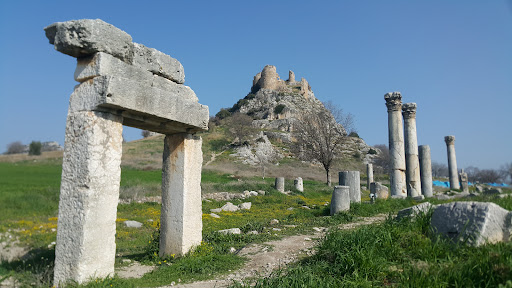
North of the Ceyhan River, dominating the small alluvial plain between Kesmeburun and Bahçeköy atop a prominent rocky outcrop, rises a medieval fortress bearing the name Bodrum Castle. Located 110 km from Adana along the scenic road linking Osmaniye to Aslantaş Dam and the Karatepe-Aslantaş Open-Air Museum, the architectural ruins of the ancient city can still be observed surrounding the fortress today. The historical identity of this ancient city was identified as Hieropolis-Castabala only toward the end of the 19th century thanks to ancient inscriptions discovered in the locality. Since that time, international researchers from various nations have studied the monuments, inscriptions, and coinage of Castabala, making it possible to illuminate the rich history of the ancient city. Architectural remains visible today at the Castabala archaeological site date entirely to the Roman Period. From the asphalt road connecting Castabala to Karatepe, one can observe the 300-meter-long colonnaded avenue constructed around 200 AD. Passing beside the rocky crag crowned by the fortress, this colonnaded avenue descends into the valley behind, which formed the primary civic settlement precinct. On the elevated terrace overlooking this valley, numerous inscribed statue bases have been brought to light. The level terrain extending from here down to the valley was the ancient stadium. On the hillside slope just beyond stands the remarkably well-preserved theater. Facing the theater are the architectural remains of a Roman-period bathhouse complex. Furthermore, two church edifices dating to the 5th and 6th centuries AD attract attention; one of these stands directly adjacent to the colonnaded avenue and was built using architectural elements dismantled from earlier Roman Imperial buildings. Numerous monumental tomb structures and rock-cut chambers surround the city. Urban water requirements were supplied from a copious freshwater spring situated near Karagedik Village on the eastern bank of the Ceyhan River. The territory belonging to Castabala's revered goddess Perasia—evidently a venerable ancient religious sanctuary—was extensive, reaching north to modern Karatepe and Bahadırlı villages and south across the fertile agricultural plain irrigated by the winding loops of the Pyramus (Ceyhan) River. Hieropolis-Castabala was an eminent sacred center. According to Strabo of Amasya, the priestess at the sacred sanctuary of Artemis Perasia in Castabala entered intense ecstatic trances following extended ritual dances, treading barefoot over glowing hot embers akin to Rufai dervishes, and at the summit of divine ecstasy dashed forth from the temple bearing a blazing torch toward the mountains, deep ravines, and wooded slopes of the Ceyhan. Sacred Panhellenic athletic games were likewise held here in Perasia's honor during Hellenistic and Roman Imperial eras. Civic coinage depicted a turreted female head symbolizing the city, before which stood a torch and a pine tree—emblems of the patron goddess Perasia. Strabo's goddess Artemis Perasia of Castabala was none other than Kubaba herself. Excavations reveal that Castabala's cult sanctuary was vastly older than once presumed and that the mother goddess Kubaba was its original sovereign. Kubaba is the ancient name of the great Anatolian Mother Goddess whom we know as Cybele. In ancient records, this name first appears around 1800 BC during the Assyrian Colony Period in the cuneiform archives of Kültepe and within royal archives of the Hittite capital Boğazköy (Hattusa) dating between 1500 and 2000 BC, cited among divine names. Following the collapse of the Hittite Empire around 1200 BC, Carchemish served as capital of the Neo-Hittite realm, where Kubaba became supreme deity and was venerated as the "Queen of Carchemish". Her cult spread with immense velocity; reliefs celebrating her exist at Domuztepe. Embraced by the Phrygians, we encounter Kubaba at Pessinus and Sardis. Her sacred effigy was transported to Rome in 204 BC and enshrined upon the Palatine Hill. In the Greco-Roman period, she was venerated as Artemis Perasia. In the Late Roman Period during the 5th century AD, we witness a phenomenal explosion in olive oil production around Karatepe and Düziçi: oil-press stones and mill remnants occur at every turn, alongside basilicas with polychrome floor mosaics and shrines spaced every 7 to 10 kilometers. Olive oil was accumulated at Hieropolis-Castabala before being transported down to harbor ports along the Gulf of Issus. At Roman-era Hieropolis-Castabala, numerous inscriptions and coins belonging to Roman governors and independent local client kingdoms have been found. These client dynasties ruled Castabala until roughly 17 BC, most renowned among them being Tarkondimotos I and Philopator II, who minted autonomous civic coinage. National independence was attested by minting one's own valid currency. DOWNLOAD MUSEUM BROCHURE NEARBY MUSEUMS OSMANİYE KARATEPE ASLANTAŞ MUSEUM AND ARCHAEOLOGICAL SITE OSMANİYE MUSEUM
Let AI build your tour plan
Kastabala Archaeological Site
3-Stop Personal Tour Plan
VISIT INFO
Museum visit information
Address
80000 Kesmeburun/Osmaniye Merkez/Osmaniye, Türkiye
Ticket
Not listed
Opening Hours
- Opening09:00
- Closing19:00
- Box office closing18:30
- Closed daysOpen every day
Phone
03288250674
Frequently Asked Questions (Kastabala Archaeological Site)
Opening: 09:00 · Closing: 19:00 · Box office closing: 18:30 · Closed days: Open every day
Neleri Meşhur İşbirliği
Kastabala Archaeological Site çevresinde ne meşhur?
Neleri Meşhur'da bakın — lezzet, gezi ve yöresel keşif tek yerde.
OSMANİYE
Explore in the same city

Karatepe Aslantaş Museum and Archaeological Site
