 MüzeKartGeçerli
Karatay (Çini Eserler) Museumvisitor guide.
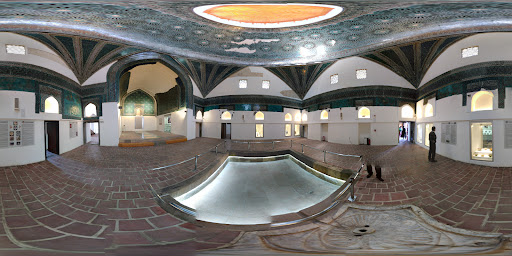
The Madrasa is situated on Adliye Boulevard in Ferhuniye Neighborhood of Karatay District, north of Alaeddin Hill in Konya. Karatay Madrasa was commissioned in 649 AH (1251 AD) during the reign of Sultan Izz al-Din Kaykawus II by Emir Jalal al-Din Karatay. Its architect is unknown. Also utilized in the Ottoman Era, the madrasa was abandoned in the late 19th century. Built of local Sille stone in the 'Enclosed Madrasa' plan to instruct students in Hadith and Quranic exegesis during the Seljuk era, it has a single story. Entrance from the east is via a monumental portal of celestial and white marble, representing a masterpiece of Seljuk stonemasonry embellished with elegant calligraphy and geometric relief patterns. Above the doorway are construction inscriptions concerning the building, while other surfaces feature selected Quranic verses and Hadiths carved in relief. From the portal, one enters an originally domed (now open) courtyard, and from there enters the madrasa hall through an inner doorway. The central hall of the madrasa is surmounted by a dome with a central lantern, lavishly revetted in mosaic tiles. Quranic verses are inscribed along the dome's drum, the upper wall friezes, and the panels above cell doorways. In the arch of the barrel-vaulted western iwan, the Basmala and Ayat al-Kursi are carved. In the transitional pendentive triangles supporting the dome, the names of Prophets Muhammad, Jesus, Moses, and David appear alongside the four Rightly Guided Caliphs (Abu Bakr, Umar, Uthman, and Ali). The domed cell to the left of the iwan is the tomb of Jalal al-Din Karatay. Most mosaic tiles on the walls have fallen away; colors utilized include turquoise (firuze), dark blue, and black. Holding an eminent place in Anatolian Seljuk tile craftsmanship, Karatay Madrasa was opened to visitors in 1955 as the 'Tile Works Museum.' The displayed works belong to Anatolian Seljuk and Ottoman eras. In the cell housing Jalal al-Din Karatay's tomb and in southern student cells, tiles from Kubadabad Palace, stucco decorations, tile plates, oil lamps, and unglazed ceramics are exhibited. The tiles from Kubadabad Palace—star, cross, half-cross, and square in shape—were produced using luster and underglaze techniques. Built by order of Alaeddin Kayqubad I, Kubadabad Palace was discovered in 1949 by Konya Museum Director Zeki Oral after İbrahim Hakkı Konyalı and Prof. Dr. Osman Turan pointed out it should be near Beyşehir. Following sounding excavations by Zeki Oral in 1952, Katharina Otto-Dorn in 1965–1966, and Mehmet Önder in 1967, Kubadabad was left abandoned for a long period until systematic excavations resumed in 1980 under Prof. Dr. Rüçhan Arık. The iwan displays Seljuk tile fragments and Seljuk and Ottoman pottery; the domed hall features Seljuk glassware, tile sherds, ceiling centerpieces from Beyşehir Eşrefoğlu Mosque, and Ottoman ceramics. DOWNLOAD MUSEUM BROCHURE NEARBY MUSEUMS MEVLANA MUSEUM KONYA EREĞLİ MUSEUM KONYA ARCHAEOLOGY MUSEUM KONYA ATATÜRK HOUSE MUSEUM KONYA ETHNOGRAPHY MUSEUM ÇATALHÖYÜK ARCHAEOLOGICAL SITE
Let AI build your tour plan
Karatay (Çini Eserler) Museum
3-Stop Personal Tour Plan
VISIT INFO
Museum visit information
Address
Ferhuniye, 42040 Selçuklu/Konya, Türkiye
Ticket
Not listed
Opening Hours
- Opening09:00
- Closing19:00
- Box office closing18:30
- Closed daysOpen every day
Phone
03323511914
GUIDES
Before you visit

Frequently Asked Questions (Karatay (Çini Eserler) Museum)
Opening: 09:00 · Closing: 19:00 · Box office closing: 18:30 · Closed days: Open every day
Neleri Meşhur İşbirliği
Karatay (Çini Eserler) Museum çevresinde ne meşhur?
Neleri Meşhur'da bakın — lezzet, gezi ve yöresel keşif tek yerde.
KONYA
Explore in the same city

80 Günde Devr-i Alem Parkı - Meram Belediyesi
Agaç işleri Ahmet Işıkçeviren
