 MüzeKartGeçerli
Agora Archaeological Sitevisitor guide.
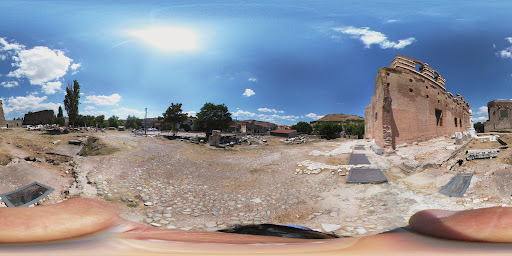
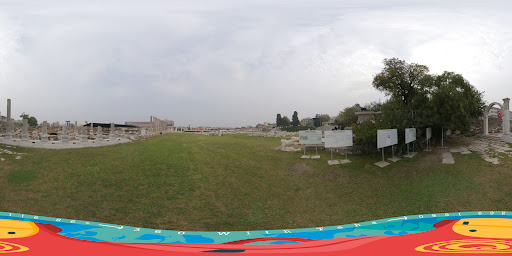
İZMİR AGORA ARCHAEOLOGICAL SITE Located in the Kemeraltı locality of Konak District in İzmir, the Agora Archaeological Site was the administrative, social, cultural, and religious center of ancient Smyrna, founded between Kemeraltı and Kadifekale during the Hellenistic and Roman periods. A substantial portion of the remains in the Agora Archaeological Site dates to the 2nd century AD. The word 'Agora' signifies 'city square, marketplace, bazaar.' Following the Hippodamian urban plan, it was constructed on three levels near the city center. It is regarded as the largest and best preserved of Ionian agoras. Initial excavations in the Agora were conducted in its northwestern section between 1932 and 1941 by R. Naumann and S. Kantar. Excavations resumed briefly on behalf of İzmir Museum between 1996 and 1998, and restarted in 2002 under the museum. INSCRIPTION RECOUNTING THE EARTHQUAKE Rectangular in form, it is a three-tiered composite structure built upon columns and arches around a spacious central courtyard, with a stairway in front. The relief of Goddess Vesta at the northern gate of the Agora proved to be a continuation of the Zeus Altar reliefs uncovered during early excavations. In addition to statues of Hermes, Dionysus, Eros, and Heracles, numerous male, female, and animal statues, reliefs, figurines, and marble, bone, glass, metal, and terracotta artifacts were unearthed. Inscriptions of the ancient city also provide information regarding those who provided aid following the earthquake of 178 AD. TO BECOME AN ARCHAEOLOGY AND HISTORY PARK Excavations conducted by the İzmir Archaeology Museum Directorate uncovered the basilica, a large section of the western stoa, and the northern end of the eastern stoa. Restoration projects carried out concurrently re-erected the 'Faustina Gate.' In addition, work continues on completing western stoa facade columns and missing arches in the basement levels of the basilica and western stoa. Within the project scope, extensive landscaping will extend westward to Eşrefpaşa Avenue (İki Çeşmelik Slope) and northward to Anafartalar Avenue. Thus, uncovering buildings known to relate to the agora in Antiquity, the goal is to create an archaeology and history park in the city center. WHILE YOU ARE HERE In the same district, be sure to see the İzmir Clock Tower, the symbol of the city opposite the governorate. Built in 1901 for the 25th anniversary celebrations of Sultan Abdülhamid II's accession, it stands 25 meters tall on four tiers with an octagonal plan. North African capital columns, horseshoe arches, and densely ornamented facades reflect North African and Andalusian architecture. Designed by French-Levantine architect Raymond Charles Père of İzmir, its clock was gifted by German Emperor Wilhelm II. DOWNLOAD MUSEUM BROCHURE NEARBY MUSEUMS EPHESUS ARCHAEOLOGICAL SITE AYASULUK CASTLE EPHESUS MUSEUM ST. JOHN ARCHAEOLOGICAL SITE PERGAMON RED BASILICA ARCHAEOLOGICAL SITE EPHESUS TERRACE HOUSES
Let AI build your tour plan
Agora Archaeological Site
3-Stop Personal Tour Plan
VISIT INFO
Museum visit information
Address
Namazgah, Tarik Sari Sokağı No:29, 35240 Konak/İzmir, Türkiye
Ticket
Not listed
Opening Hours
- Monday08:30–17:30
- Tuesday08:30–17:30
- Wednesday08:30–17:30
- Thursday08:30–17:30
- Friday08:30–17:30
- Saturday08:30–17:30
- Sunday08:30–17:30
Phone
+90 232 489 07 96
GUIDES
Before you visit
Frequently Asked Questions (Agora Archaeological Site)
Monday: 08:30–17:30 · Tuesday: 08:30–17:30 · Wednesday: 08:30–17:30 · Thursday: 08:30–17:30 · Friday: 08:30–17:30 · Saturday: 08:30–17:30 · Sunday: 08:30–17:30
Neleri Meşhur İşbirliği
Agora Archaeological Site çevresinde ne meşhur?
Neleri Meşhur'da bakın — lezzet, gezi ve yöresel keşif tek yerde.
İZMİR
Explore in the same city
Ayasuluk KALESİ
Ayasuluk - St.Jean Archaeological Site